
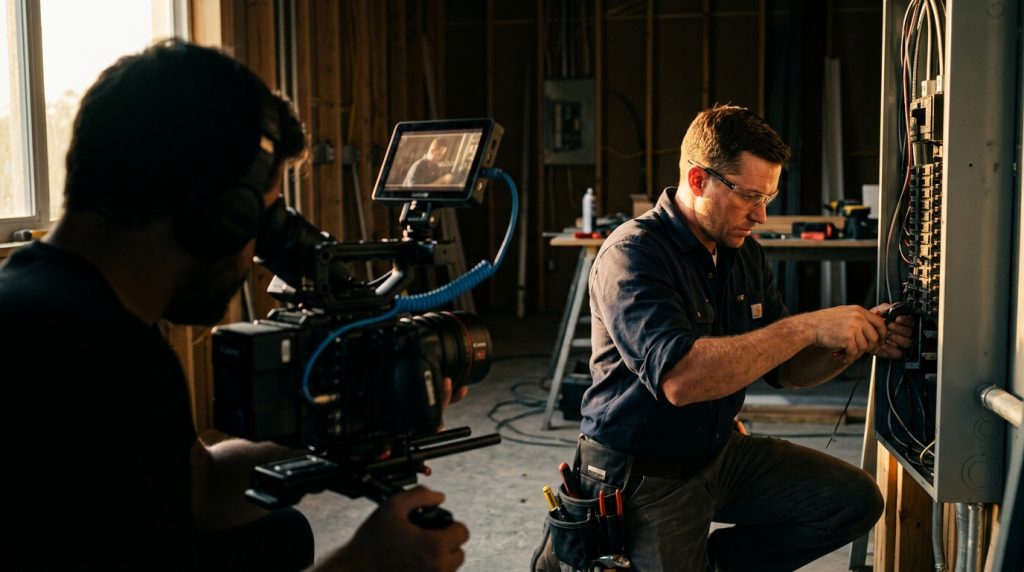
Air conditioning, plumbing, electrical and roofing have something in common in Florida: they are the four systems an insurer looks at in a 4-point inspection. Most of Spring Hill was built from the 1970s through the 1990s, so a lot of homes here are old enough that the insurance company wants a report on exactly those four things. That puts these trades in front of the same homeowners, often in the same month, for very different reasons.
So this guide doesn’t hand all four trades the same advice. Each section covers what that customer is actually worried about when they call, the questions they ask, and the videos that answer those questions before your truck pulls up. Jump to yours:
What the four trades share, and where they split
Every one of these customers is letting a stranger into their house or onto their roof, and none of them can judge the work on their own. That part is shared. What changes is the moment they find you. An AC customer is hot and in a hurry. A plumbing customer may have water on the floor. An electrical customer is often scared and can't say why. A roofing customer has usually been burned, or knows someone who was. The video that wins the job is the one that speaks to that moment, so a single generic company video only gets you partway there.
HVAC: the August call
Picture a Saturday in August. The system quits mid-afternoon, the thermostat climbs past 85, and the homeowner has maybe ten minutes of patience to pick a company. They aren't comparing warranties. They're asking three things: can someone come today, is this a repair or a whole new system, and is this company going to upsell me because I'm desperate?
Your videos should answer those three questions in order:
- A tech at the condenser explaining repair versus replace. Two minutes of a calm tech saying "here's when we fix it, here's when we tell you it's time" does more for the upsell fear than any slogan.
- The dispatch and trucks. Show the board, the vans rolling out, the tech calling ahead. It answers "can you come today" without a promise you might not be able to keep in a heat wave.
- A shoulder-season maintenance clip. October through April is when Spring Hill homeowners have the patience to book a tune-up. A short clip on what a maintenance visit checks fills the slow months.
- Coastal coil damage. Homes out toward Hernando Beach and Hudson take salt air, and outdoor units show it. A close-up of a corroded coil next to a clean one is the kind of thing people save and share.
That's the Airheads AC commercial we made. Notice what carries it: the people who actually show up at the door. For an HVAC company, that's the whole sale.
Plumbing: water on the floor
Plumbing calls split into two kinds, and they need different videos. The first is the emergency: a burst supply line, a backed-up drain, a water heater leaking into the garage. That customer wants to know how fast you can get there and whether you'll treat their house with care while you're in it. The second is the big decision, and in Spring Hill that's often a repipe. Plenty of homes from the late 70s through the mid 90s were plumbed with polybutylene, and insurers and inspectors flag it.
The questions you hear on those calls are specific. "Where's my main shutoff?" "Do I really need to repipe the whole house, or can you patch it?" "Will you tear up my walls?" "Why is there white crust on every faucet?" That last one is the hard water most of Hernando County lives with, and it's a great short video on its own.
- The "until we get there" clip. Thirty seconds on finding and closing the main shutoff. Pin it on your Google profile. People find it while the water is still running, and they remember who helped.
- A repipe walk-through. Follow one job from the first wall opening to the patch and paint. It answers "will you wreck my house" better than any sentence on a website.
- Shoe covers and drop cloths. It sounds small. On camera, a plumber who protects the floor before touching anything is the difference between a stranger and someone you'd let back in.
- The water heater decision. Tank versus tankless, explained by your own plumber standing next to both.
Electrical: the work nobody can see
An electrician's best work disappears behind drywall and a panel cover. The homeowner can't inspect it and knows a mistake could start a fire, so they size up the person instead. A lot of them look you up on the state's license lookup before they call. Older Spring Hill houses add a twist: some still have panel brands that Florida insurers flag on a 4-point, and the homeowner finds out from a letter, not from you.
After the outages that followed Hurricane Milton, the other big question here is backup power. Homeowners who sat in the dark for days now ask what size generator they need, whether a portable unit can tie into the house safely, and how long a standby install takes from permit to first test.
- The panel explainer. Your electrician with the cover off (power safely isolated), pointing at what a flagged panel looks like and what replacing it involves. This is the video that books panel jobs.
- Generator sizing, start to finish. Walk a real install: the pad, the transfer switch, the inspection, the first test run. Publish it in May, before the season, when people are still planning instead of panicking.
- Warning signs, filmed plainly. A warm outlet, a breaker that won't stay reset, lights that dim when the AC kicks on. Short, calm, no scare music.
- The EV charger install. Newer neighborhoods along the Suncoast Parkway are full of EVs, and the owners search for this exact job.
Roofing: after the storm chasers
Roofing customers in Hernando and Pasco have a long memory. After Helene and Milton, out-of-town crews knocked on doors up and down the coast, and most neighborhoods have a story about one that took a deposit and left. So the homeowner's first question isn't about shingles. It's "will you still be here in five years when something leaks?"
Florida also changed the rules on how roofers can go after insurance claims. Contractors can't offer to cover a deductible or hand out incentives to get a homeowner to file. That matters for your video. A storm-season video should teach people what damage looks like and leave the claim decision to them. It shouldn't sound like a pitch to file one. Done that way, it builds more trust than any door-knocker can.
- The tear-off day. Show the decking when the old roof comes off, the rotten sheets getting replaced, the underlayment going down. It explains your number better than a line item ever will.
- The yard and the crew. Your shop, your trucks, your foreman by name. That's what "local and staying" looks like, and it's the one thing a storm chaser can't film.
- What damage looks like from the ground. Lifted tabs, missing ridge caps, granules in the gutter. Helpful, specific, and nothing about filing.
- The finished roof from above. Aerial footage of a clean, finished roof is where the job ends, and it's the shot people share.
That one is a garage door job, not a roof, but it's the same idea: storm-hardening a Florida house, shown step by step so the homeowner sees what they're paying for. A roof replacement filmed that way does the same job.
How one shoot day covers all of it
You don't need a film crew living at your shop. Pick one or two good jobs, we schedule around the work, and we stay out of your crew's way while they do what they already do. From one day on site you get a main video for your homepage and Google Business Profile, shorter cuts for ads, and vertical clips for Facebook and Instagram. The tracks we use are commercially licensed, so your ads won't get muted or flagged for the music.
That's The Contractor, a day on a slab pour. It's the film we show trades owners when they ask what theirs would look like. You can see more trade work, from tree crews to land clearing, in our portfolio.
If you're still deciding who to hire, we wrote up the difference between a videographer and a production company and what to look for in one. Other trades have their own pages: land clearing, landscaping and sod, tree service and garage doors.
We're in Spring Hill and work with trade companies across Hernando and Pasco: Brooksville, Weeki Wachee, Hudson, New Port Richey and the rest of Tampa Bay. Book a Free 30-Min Call or call Josh at 352-754-0279, tell us which trade you're in, and we'll tell you the first video we'd make for you.
Frequently asked questions
Which video should a trade company make first?
The one that answers the question your customers ask most on the phone. For HVAC that's usually repair versus replace, for plumbing it's the emergency shutoff, for electrical it's the panel or generator, and for roofing it's proof you're local and staying.
Will filming slow my crew down on a job?
No. We plan the shoot around a job you already have booked and film the work as it happens. Your crew works; we stay out of the way and ask for a few minutes of talking at the end.
Do I or my techs have to be on camera?
It helps, because homeowners are hiring the people, not the logo. It doesn't need to be polished. We keep it conversational and cut around the stumbles.
Can one shoot give me ads and social content too?
Yes. One day on site usually covers a main video plus shorter ad cuts and vertical clips for social. The music is commercially licensed, so ads aren't muted or flagged.
Do you work with plumbers, electricians and roofers outside Spring Hill?
Yes. We're based in Spring Hill and film across Hernando, Pasco and Citrus, including Brooksville, Hudson, New Port Richey and the rest of Tampa Bay.