
For Hernando County businesses with happy customers and a thin Google profile. Here's the review setup we built for a Brooksville land clearing company that had zero reviews in August.
The work is good, the customer says thanks in the driveway, and the Google profile still shows a handful of reviews from two summers ago. A competitor with a longer list sits above you on the map, and a homeowner in Brooksville or Spring Hill comparing the two picks the one with more neighbors vouching for it.
When the work is good and the reviews are thin, look at the ask first. Maybe nobody asked, or the ask came without a link, or twenty customers got a text one Saturday and nobody followed up. Reviews come from a habit: the right moment, one tap to the review form, and a nudge about what to write.
Getting the profile itself in shape (categories, hours, photos and posts) is covered on our Google Business Profile management page. Here we cover getting finished customers to actually write. ApeShot Productions works out of Spring Hill and sets this up for businesses across Hernando County.
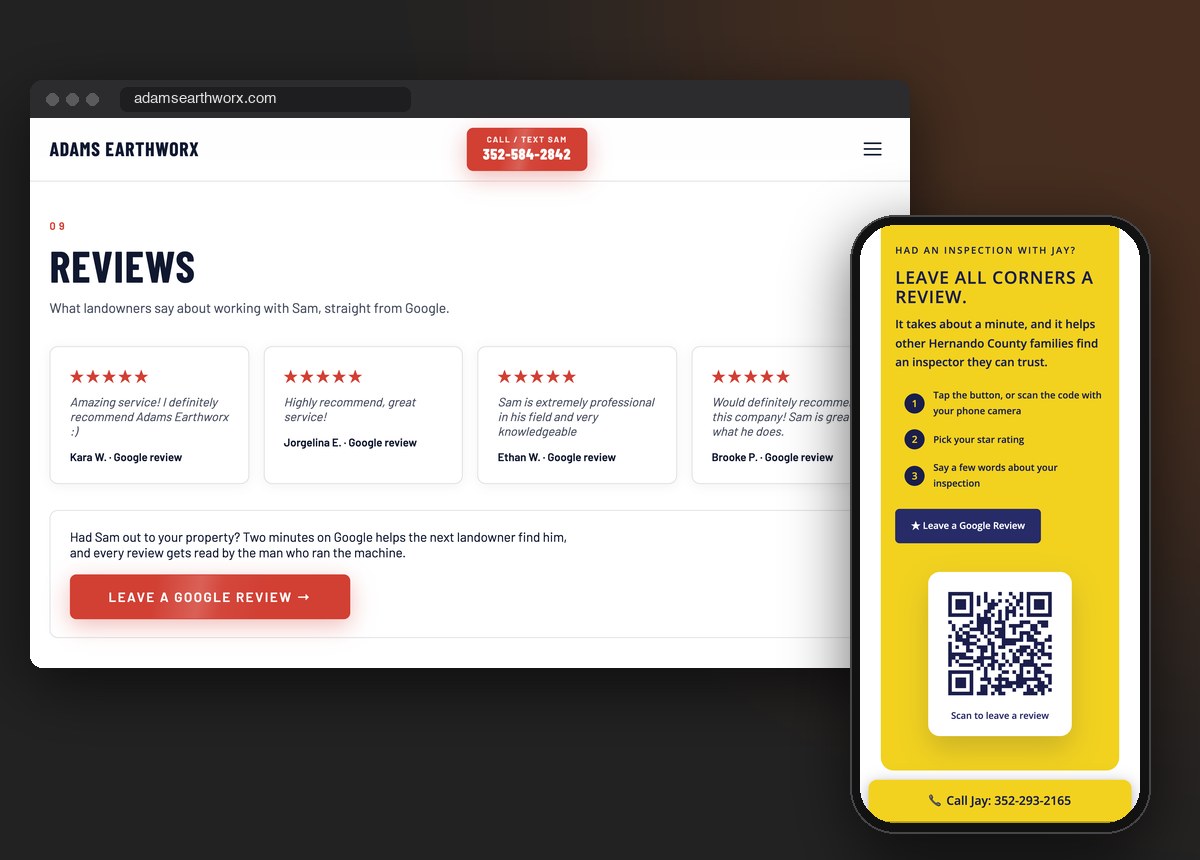
Adams Earthworx is Sam’s land clearing and site prep company in Brooksville, running since 2016. On August 18, 2026 his Google profile was verified and empty: no reviews, no hours, no description, no photos. We made a direct Google review link and put it behind the “Leave a Google Review” button on adamsearthworx.com, then built a reviews section into his homepage with an ask box under it. On September 24 the profile showed five reviews at 5.0. On October 23, 2026 it showed 5.0 from 15 reviews. The newest reads: “Great work and attention to detail highly recommend!!”
Who did what: Sam did the asking, and the people he worked for did the writing, on Google. Our part was the setup behind the ask. When we read the early reviews in late September, two had landed within 19 hours of each other. A cluster like that can look unnatural, and reviews that arrive together also go stale together, so we recommended one ask at a time, about two a week. The early reviews were also one liners, like “Highly recommend, great service!”, so we recommended an ask that invites the customer to say what job Sam did and what town it was in.
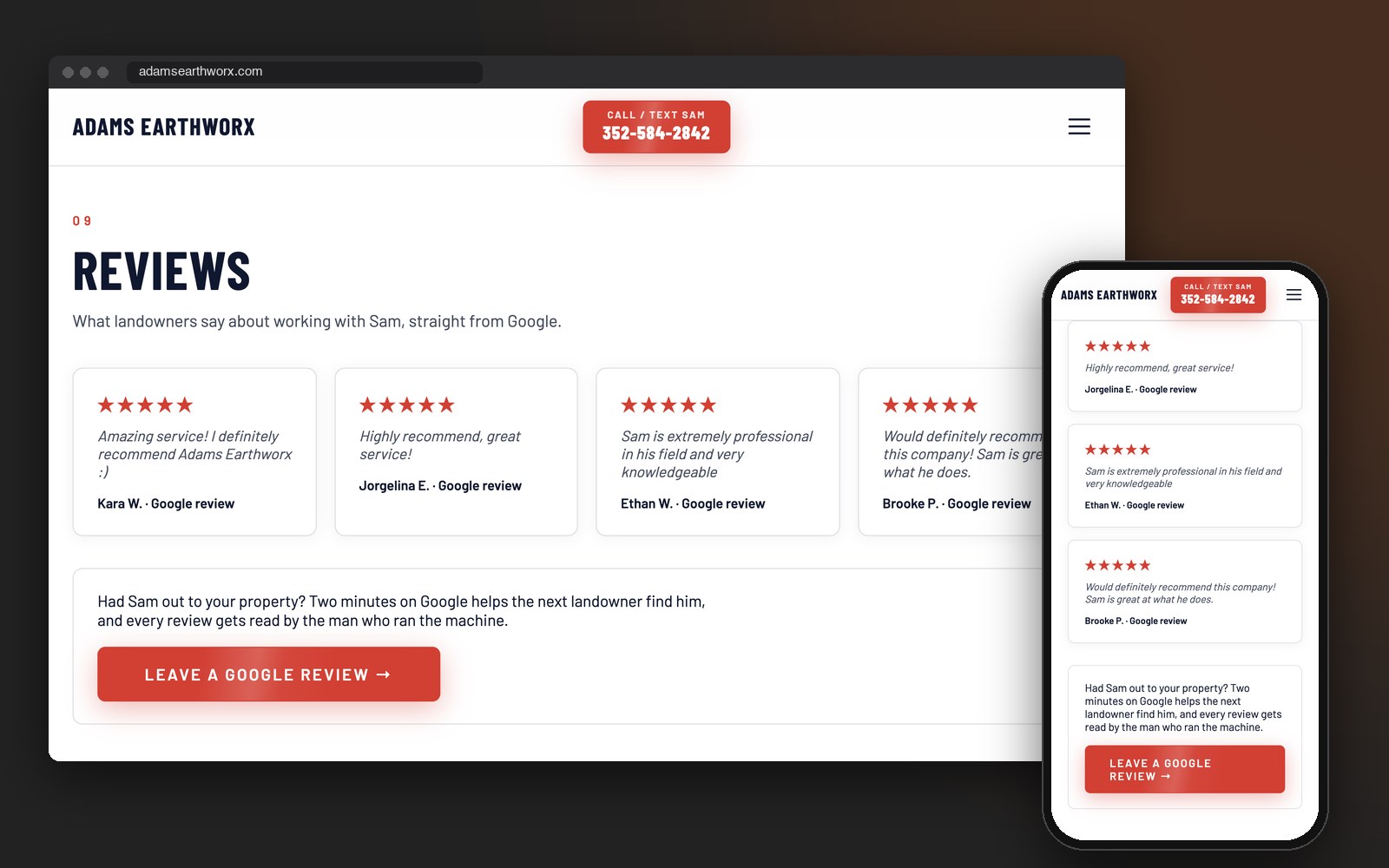
His homepage shows four Google reviews word for word, then a short box: “Had Sam out to your property? Two minutes on Google helps the next landowner find him, and every review gets read by the man who ran the machine.” One button opens his review form. adamsearthworx.com ↗
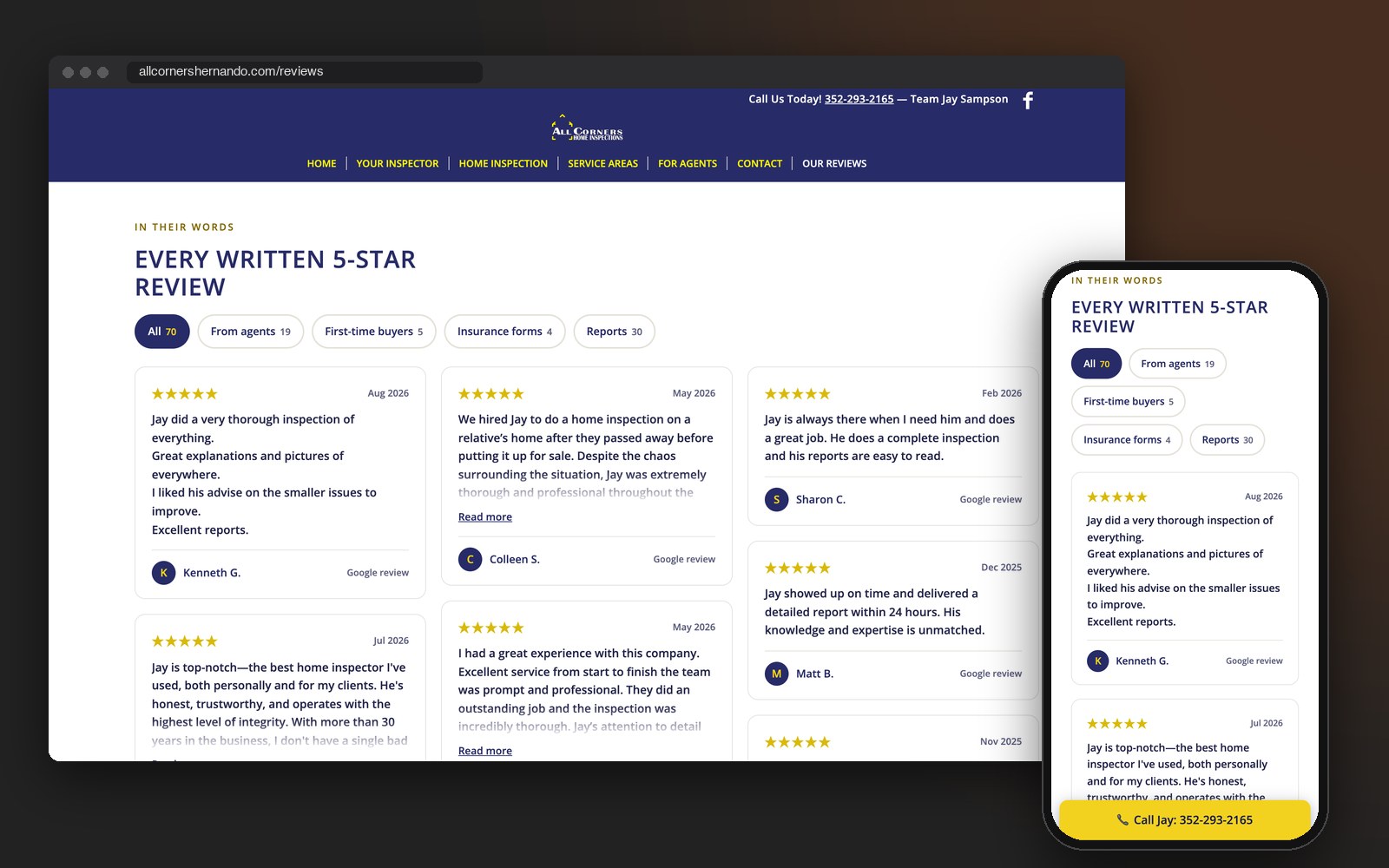
Jay Sampson’s site has a Reviews page, at allcornershernando.com/reviews, carrying every written five star review in full. At the bottom, a box headed “Leave All Corners a review.” offers a button and a code a client can scan with a phone camera, so the ask can happen at the kitchen table when the report is handed over. allcornershernando.com ↗
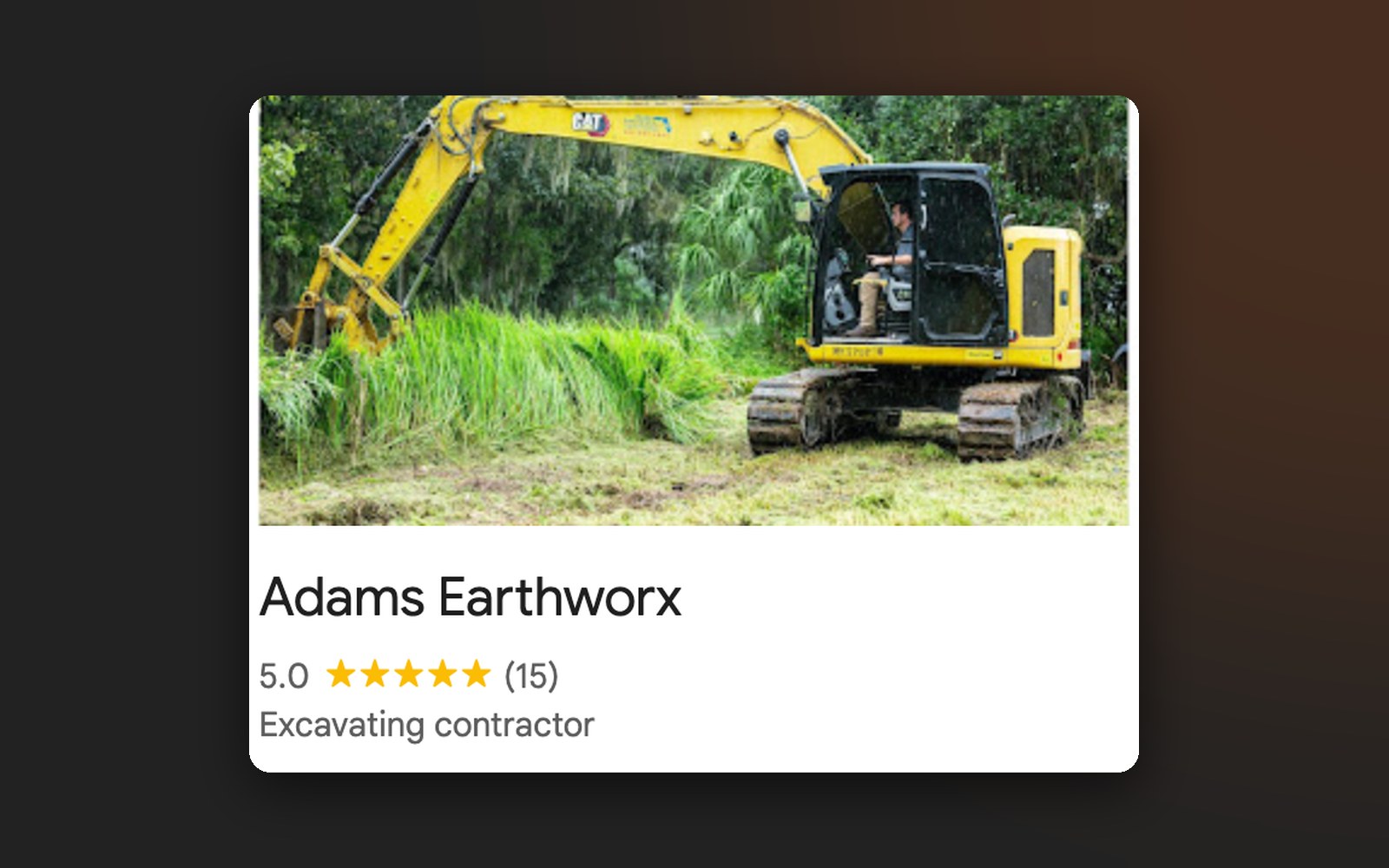
Read off the live Google profile on the night this page was written: 5.0 stars, 15 reviews.
Happy customers and a thin profile? Bring the profile to a free call and Josh will show you where the ask is breaking.
Answer yes or no. Two or more no’s means the ask is the problem, not your customers.
If no: you’re asking them to search for you, find the right listing and hunt for the button. That’s three chances to give up.
If no: past customers who visit your site to look up your number never see an invitation.
If no: choosing who gets asked is the habit Google calls review gating. Everyone gets the same ask.
If no: expect more “great service” and nothing a stranger in Spring Hill can picture.
If no: a profile whose newest review is from last spring reads like a business that slowed down.
If no: a review with no reply under it looks like nobody is minding the profile.
Verified, with your hours, a plain description of the work and photos from your own jobs. People hesitate to review a listing that looks abandoned.
One link that opens your review form with the stars already showing, plus a printed card carrying the same link as a scan code. Keep a stack in the truck.
A short message that sounds like you and asks the customer to mention what you did and where. We write it with you. You or your crew send it.
Your real Google reviews shown word for word, with an ask box and button underneath. We add it to the site you have, or build it into a new one through our website design work.
About two a week, spread across finished jobs as they wrap. Never a list of customers texted on the same afternoon.
We draft a reply for each new review, you approve it, then it posts. Once your Google ads account is linked to the profile, the star rating can show on your Google ads as well.
A verified profile can still sit at zero reviews, like the Adams Earthworx profile on August 18. These are five ways an ask goes wrong, and what to do instead.
| The ask | Why it fails | What we set up instead |
|---|---|---|
| “Leave us a review sometime” | No link and no moment. It’s easy to forget before they reach the end of the driveway. | A direct link, handed over or texted while the finished job is in front of them |
| A discount or gift card for a review | Google’s review rules don’t allow incentives, and Google can take down reviews it finds were bought that way. | A plain ask. The work is the reason. |
| Only asking customers you know loved it | Google calls that review gating and doesn’t allow it. | The same ask to every finished customer |
| Ten texts the same afternoon | A burst can look unnatural, and those reviews all grow old in the same week. | One ask at a time, about two a week |
| Reviews from family and staff | Google treats them as a conflict of interest. | Real customers only |
The profile is filled out, the review link is tested on a phone, the QR cards are printed and the ask text is saved where you can find it. This part happens once.
While the customer is standing in front of the finished work, ask in person. Hand them the card or text the link right there.
If they said yes and nothing has shown up, send one short follow up with the link again. One. After that, let it go.
Count the new reviews, reply to any without a reply and read what customers wrote. If they’re still writing one liners, we change the wording of the ask.
The habit on this page is one ask per finished job, about two a week, never a batch. The hard part is remembering which jobs just wrapped. Since October 22, 2026, website form leads on Holmes Drafting’s and Care Smith’s sites land in one list that moves each lead from new to won, with what the job was worth.
Won in that list means signed, not finished. So treat the Won column as the jobs to watch: when one of them wraps, that customer is next to ask. Still one at a time, still about two a week. The owner or the crew still sends every ask; nothing goes out on its own. Here is the list that shows which leads became jobs.
Bring your Google profile to a free call and we'll walk through the link, the wording and the timing with you. What it costs depends on which pieces you need, from the link and the wording up to the website section and replies. Josh walks through that on the call with your profile open.